Python can operate with numbers using the usual mathematical operators, and some special operators, too.
👇👇👇Click Read more
Python can operate with numbers using the usual mathematical operators, and some special operators, too.
👇👇👇Click Read more
Python is a Calculator
I can hear you say, "All programming languages can calculate". But python does it in easy syntax.
5 plus 7 is 12, 13 times 15 is 195, 1 divided by 5 is 0.2. Easy. Repeating or periodic numbers are printed in a longer format. Let's try minus 2 divided by 3. In math theory, when 2 is divided by 3, the digit 3 repeats forever after the decimal point.
👇👇👇Click Read more
👇👇👇Click Read more
Hello World!
If you downloaded and installed Python software on your computer, it means you are ready to learn.
Lets start to type codes and small programs.
First one is Hello world!
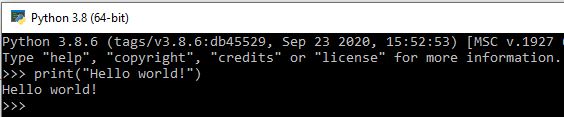
To display any text as message or information on the screen, you can just type the print function with the following signs and texts as below.
print("Hello world!")
Then under this code, you will see the text as below.
Hello world!
What is programming?
At a basic level, a computer program is a recipe of instructions that tells your computer what to do.
When you write a program, you create a step by step recipe of what needs to be done to complete a task and when your computer executes the program it reads what you wrote and follows your instructions to the letter.
The recipe is written in a code called programming language. Programming languages are actually similar to human spoken languages since they have a syntax and semantics.

Why Python?
There are a few reasons. First of all, programming in Python usually feels similar to using a human language. This is because Python makes it easy to express what we want to do with syntax that's easy to read and write.
Secondly, Python makes it easy to express the fundamental concepts of programming like data structures and algorithms with easy to read syntax. This makes Python a great language to use to learn programming.
The other reason is to pick that Python is super popular in the IT industry, making it one of the most common programming languages used today.
You can use Python to calculate statistics, run your e-commerce site, process images, interact with web services, and do a whole host of other tasks.
Python is perfect for automation. It lets you automate everyday tasks by writing simple scripts that are easy to understand and easy to maintain. That's why Python is the language of choice for lots of people working in IT support, system administration, and web development.
History of Python
Its first version was released by Guido van Rossum back in 1991. Since then, the community that develops it has grown and the language has advanced a lot. Whenever there's a significant change to the semantics or syntax of the language, a new major version is released. In 2000, Python 2 was released. In 2008, we got Python 3. Python 3.7 came out in 2018.
Which Operating Systems?
Python is available for download on a wide variety of operating systems, like Windows, Linux, and Mac OS.
Source: Crash Course on Python in Google IT Automation with Python Professional Certificate
Installation of Python
We are suggesting to download Python from their original website.
https://www.python.org/downloads/

